Loon Lake 2018

Loon Lake 2018

Isabelle Saint-Guily and Carl Inglin invited me to join their private trip scheduled for the new moon in July. The one-hour drive from Santa Rosa to Napa was through luscious vinyards. Liam joined us on the trip, so there were four of us who had camped in Loon Lake together in 2014. This time, I paddled Isabelle’s kevlar canoe with her — the boat’s first time in the water in two years. Carl paddled a solo canoe with us, putting in on Thursday afternoon. Liam wanted to make sure we got a good site, so he left Novato with his kayak at 5 a.m. on Thursday and scouted several sites, selecting a great one in Pleasant Campground near a beach and near the refurbished composting toilet. Carl, Isabelle and I were on the water at 2:30 p.m. and the wind was at our backs, so the paddle took only about an hour.

Loon Lake Sunrise – Photo by Isabelle

Carl and Isabelle were up early every morning, making coffee out on the rocks, painting and reading. It was a surprise to find that I was not the first one up. The campsite was quiet and dark at night because of the new moon, and shady during the day.

Carl and Isabelle in the AM


Carl


The Fast Moving Weasels Were a Challenge to Photograph, But Carl Succeeded

Liam

Liam had this map with him, and he thinks we were in campsite six. The island was farther away and Isabelle swam out there to discover it was a bird nesting area — but no Loons!

Loon Lake Pleasant Campground

Carl found this great old map showing the lakes before they were flooded to create water supply for SMUD.

Before The Lakes Were Water Supply

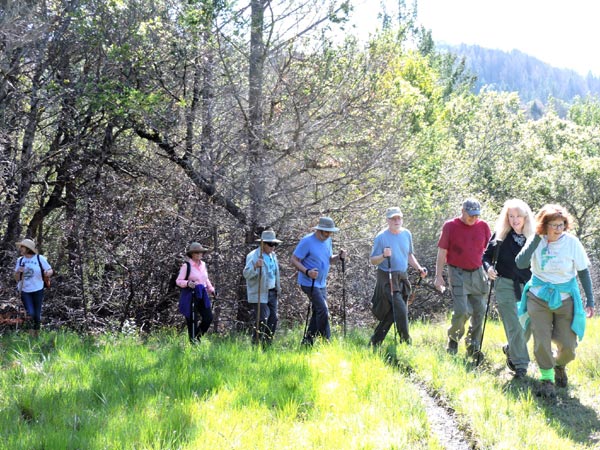
We enjoyed short hikes, but we could feel the altitude. Friday was pretty quiet during the day, but Friday night and Saturday morning the campsites around us started to fill up. We had to do some trail adjustment to deter hikers from walking through our camp. The trail marker sign was broken so we made the correct trail for hikers more visible by clearing it and lining it with light-colored stones.

Hiking Near Pleasant Campground

Friday night we hiked up the rocks to watch the sunset. Carl got this great shot.

Loon Lake Sunset by Carl

We were all thrilled to learn that France was playing in the World Cup Final on Sunday 15 July and Isabelle needed to return to Napa to watch it with her Alliance Francaise friends, so we left Saturday after breakfast and stopped for lunch during the drive home. Liam had scouted a lily pond so we checked it out on the paddle back.


On the way back, Isabelle, Carl and I stopped at Bassi campground to wade in the stream and enjoy our lunch. Traffic was slow at 4 p.m. as we drove through Vacaville and traffic was stopped where 121 and 116 join to connect with the 101 freeway so I took highway 12 through Sonoma to get home. A beautiful end to a fun and relaxing camping trip.

70th Surprise for Cousin Steve

70th Surprise for Cousin Steve

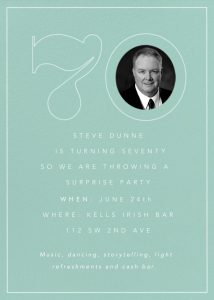
A very successful surprise party for my first cousin Steve at Kells Pub in Portland.

I was tasked with getting him to the restaurant without tipping the surprise. I told him that I was shopping in downtown Portland and that I would like to meet him for a bite to eat at 2:30 and told him that I would love a glass of Guinness. He suggested Kells (thank heaven!). Everyone gathered in the upstairs part room at 2 o’clock and took down the sign on the door “Dunne Family Party.”
Steve was on time, and as I was going through the motions of a complicated business transaction which I would have to ask for “a quieter space — do you know anything?” — my sister Laurie walked in because she was late coming from work and the sign was down. She made a hurried excuse and Steve didn’t really take notice. He suggested that we could find some quiet upstairs in the meeting room of the Ancient Order of the Hibernians (thank heaven).

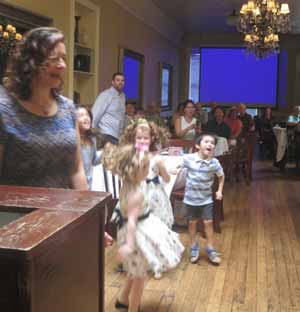
Up the elevator we went, me thanking my sainted aunt, when Steve walked right past the silent party room to a small room in the corner and opened the door. I could see a ladder in the room and Steve said, “Oh, no. There are no chairs. It looks like they are painting.” I brightened and walked him back to the correct door and waited for him to open it for me, then stepped back as he saw it was full of shrieking kids and his family. A great fun time.

Kiah and JJ, granddaughters of Steve. JJ’s father Matt in background.


Putting Candles on the Cake


Red Vertical Line Marks Steve the Birthday Boy

Healdsburg to Steelhead Beach

Healdsburg to Steelhead Beach

Great paddle yesterday from Veterans Memorial Park in Healdsburg to Steelhead Beach. First time I have ever paddled past Wohler Bridge. Paddling through the section that is normally portaged was a little tricky, but we all got through well. Here is a photo at launch with the Headsburg bridge in the background. The first rapid which goes under the freeway bridge is the most challenging part of this trip. Two things to remember: take the central channel (not the tiny leftmost one), prepare to zag sharply left maybe using the bottom of the boat to pinball off the rocks to make a fast zig to the right. Splashy, so a skirt would have been good. We had 400 cfs in Healdsburg with an additional 100 cfs coming in at Dry Creek. Perfect conditions, a well-matched group, a beer afterwards at Stumptown in Guerneville.

Liam, Cyrus, Whitney, Deb

That Was So Much Fun, We Did It Again Five Days Later

It’s not often that the weather is beautiful, there is enough water in the river, and the inflatable dam below Wohler Bridge is down, so we did it again Friday, just five days after the paddle above. I’m sorry I took the advice of a canoeist who told me to approach the first rapid, under the freeway bridge, to the left of the main channel. It put me in poor position for the “zag.” I would have been better to stay right in the main pillow of water and use it to do the zig-zag.

MANY more people on the Friday trip, and a much wider range of capabilities, including a first-time paddler who went over in a cross-current under Wohler Bridge and had to be lined through the tricky drop by the fish trap.

Front row: Liam, Deb, Canoe Guy, Carl, Me

Afterwards, we had a fun time at a happy hour in Windsor.

Getty Villa in Malibu Reopens!

Getty Villa in Malibu Reopens!

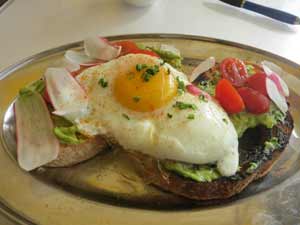
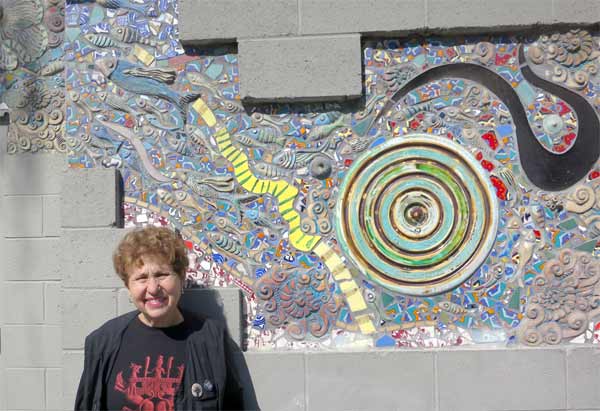
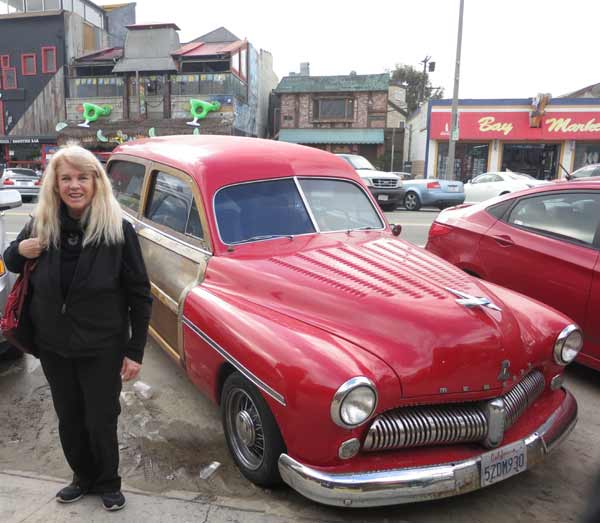
Had a great visit with my art buddy Sue Nelson who picked me up at LAX on Friday morning and whisked me to the beach for a fabulous avocado egg sandwich breakfast. Loved the woody parked on the street and the ceramic murals. Then we went to the Broad Museum to see the Jasper Johns show. We had a great lunch in the Central Market, then walked through Little Tokyo to the Hauser & Wirth gallery to see the Geta Brătescu show. She is a 92 year old Romanian with a dazzling eye wo was recently featured in the NYTimes. Best of all, we took a bus back to Sue’s car! Only cost fifty cents each and I got to see L.A. City Hall for the first time.
Oddessey

Anet with cast of Oddessey

The Getty visit was great. We had to pay for parking, but admission and tours are free with advance reservation. They had just reopened after an extensive renovation and the pools, which had been dry for years because of the drought, were filled with water. Even with all the fabulous art, architecture and gardens, they still had time to put on a silly “Oddessey” play spoofing and collapsing the epic poem into 12 minutes.

Sue and I were able to get free tickets to the 4 p.m. panel discussion including “Plato in L.A.” contributing artists Paul Chan (who was brilliant and recently published a new translation of Plato), Jeff Koons (who was profound), and Whitney McVeigh (who was the only female on the panel). The panel was hosted by guest curator Donatien Grau and the artists discussed their engagement with Plato and the creative process behind their work.

Hercules

Hercules

Here is a magnificent sculpture of Hercules. I was warming up my eyes for a planned visit to Pompeii in October.


Karen Koblitz ceramics

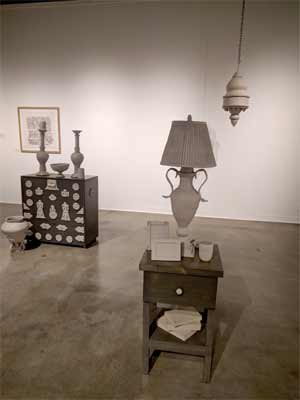
The next day, Sue drove us to a community college in Hawthorne to see the work of Karen Koblitz who was an ambassador to Azerbaijian which Sue recently visited. Karen has a lot of public art in Los Angeles area libraries, and much of her work reflects Black Sea cultures and her Jewish heritage. These artworks show a table lamp, picture frames and a hanging lamp all made in ceramic. Quite a dazzling range, and I think Sue made a new friend. She and Karen set a lunch date before we left.

On the last day of my visit, we treated ourselves to two movies: Ready Player One and The Rider. Had a great time. Thanks, Sue!

Trauma: Inherited, Denied, Healed

Trauma: Inherited, Denied, Healed

Elizabeth Rossner writes about the legacy of trauma and the labyrinth of memory in this wide-ranging review of her visits to Auschwitz with her father who came through the camps (she has a chapter on why she does not use the word “survivor” here). She also explores the legacy of trauma for the survivors and their children who experienced the killing fields of Cambodia, the retreat from Hanoi, and the massacre in Rwanda.

Traumatized people don’t feel safe, and parents who feel unsafe create households without a feeling safety, raising children do who not feel safe. The traumatized parents express the unresolved trauma in two main ways:
1. Suppressing all emotion in an effort to suppress the unrelenting, wordless fear trapped in the body. Children can’t play with someone who is numb. Children can’t bond well with someone who is numb. Drugs and alcohol often strengthen the numbness and emotional unavailability.
2. Traumatic rage squirting out uncontrollably in overreactions to upsetting everyday events. Children never know when the traumatized parent is going to beat them for a trivial infraction, or embrace them with understanding. The parent is inconsistent, and blind to the inconsistency.

Rossner quotes Dr. Maria Angeles Morcuenda, “The children of people with unresolved trauma have not learned [yet] to feel safe [even when they are] in a safe environment.”


Esther Perel says “home is the place where you feel safe, seen, appreciated, respected, and wanted.” When trauma in the home is denied, such as physical abuse, emotional abuse (betrayal and the like), or sexual abuse, the dependent child may resort to denial in order to preserve the attachment on the damaged parent upon whom she or she relies.

“Trauma denial is an act of self-preservation,” says Perel. “We employ self-delusion when too much is at stake and we have too much to lose. The mind needs coherence, so it disposes of the inconsistencies (lies) that threaten the structure of our lives. This becomes more pronounced when we are betrayed by those we feel closest to.”

Elizabeth Rossner says, “I hope my book invites readers to consider their own relationship to intergenerational transmutations of grief, trauma and resilience.” In her conversations with Dr. Morcuenda, we learn that healing from trauma is all about getting to feel safe. Dr. Morcuenda’s work focuses on “How do we make this baby, this child, resilient to the inevitable trauma life is going to bring? The work is to give each child what he or she needs, and to recognize what interferes with their ability to do that.”

Healing is seen when the trauma survivor can become fully present in the moment. Resilience can develop when we can interact fully in the moment without numbing out or slipping into the past.

Petaluma Marsh Paddle

Petaluma Marsh Paddle
Petaluma Marsh Cottage

Marsh Mellow Cottage

It was a gray Sunday when we put in at Pappa’s Taverna on Lakeville Highway, aka Lakeville Landing. Paul was there at 9 a.m. to make sure we were on the water by 10 a.m. because the wetland is tidal and opens to San Pablo Bay. High winds were predicted for 1 p.m. so we made a beeline for the cottages that are “homesteaded” in the marsh. Marsh Mellow is at left.

We drew our boats up to the private cottage and sat on the deck as we enjoyed a quick lunch before returning back, just in time before the winds started howling.

Paul Led the Paddle

Lunch at Marsh Mellow

Kathy, Richard, Deb, Wayne, Paul


Tin Ernie's Speakeasy

Lucinda and Tom at Ernie’s

Afterwards, we enjoyed some draft beer at the nearby dive bar at the crossroads of 116 and 37. We got a tall table to ourselves in the corner near the door and were delightfully surprised, as we tallied up at the end, to find that someone had already paid our tab. Paul said he didn’t do it — maybe it was Tom? Will we ever find out?

Lake Hennessey

Lake Hennessey

Paddling Lake Hennessey

Lake Hennessey Paddle with Canoe and Kayak MeetUp


Our path

Superbowl Sunday, Feb 4th, and Robert Skapura’s MeetUp group had beautiful Lake Hennessey to ourselves. Paddled with Dave Fitzgerald, Enid Pollack, Justin Morse, Rick Williams, Liam, Ann in a custom kevlar canoe and about 20 more. The lake is fed by two creeks, so first we checked out Moore Creek at the southern end, then explored the northern end of the lake to find the Conn Creek. We tandem-parked our cars in the small $4 parking area, but a red Subaru blocked in someone not in our group, so gallant Wayne paddled her car keys back and moved the car. We were surprised to learn later that the tandem parking was a ticketable offense. Good thing the patrols were not too diligent on Superbowl Sunday.

The lunch spot at the little inlet above the “k” in Lake in the map to the left is where we stopped for lunch under shady trees. Had a port-a-potty and trash bins and most boaters brought chairs and something to share for lunch. All quite fun.

Lake Hennessey sign
Robert Skapura

Come As You Are — Emily Nagoski

Come As You Are — Emily Nagoski

Come As You Are
Amazon recommended this book when I was browsing for Esther Perel titles. Emily Nagoski is a Ph.D. teaching at Smith College and this book offers the best science wrapped in very accessible language. The concepts of opening up the range of female experience and self-acceptance are wonderful and freeing. On page 332 she says, “I wrote this book because I am done living in a world where women are lied to about their bodies; where women are objects of sexual desire but not subjects of sexual pleasure; where sex is used as a weapon against women; and where women believe their bodies are broken, simply because those bodies are not male. And I am done living in a world where women are trained fro birth to treat their bodies as the enemy. I want to teach women to live with confidence and joy.”

Lemony Freshness

Descriptions on pages 62-64 of the “lemony-freshness” and “little rat jacket” experiments with the first sexual experiences of healthy young male rats raised by competent mothers who licked them enough.

In a rat’s natural environment, outside the lab, he would never need a jacket in order of feel sexy, and the smell of lemons wouldn’t make him ejaculate. The rats learned these things because humans created an environment where those things sere salient features of their sexual environment. But even things you would assume are innate — fertile female rats — must be learned by experience.

Dealing with Unwanted Feelings

How to deal with unwanted feelings (page 119) and the importance of “going through the tunnel” touching neither the brake nor the accelerator.

My technical description of [the] out-of-control experience is “maladaptive behavior to manage negative affect” — which just means trying to cope with uncomfortable emotions (stress, depression, anxiety, loneliness, rage) by doing things that carry a high risk of unwanted consequences. Compulsive sexual behavior is one example. Other examples include:

  • using alcohol or other drugs in a risky way
  • dysfunctional relationships — for instance, trying to deal with your own feelings by dealing with someone else’s
  • escaping into distractions, like movie binge-watching when you have other things you need to be doing
  • disordered eating — restricting, binging, or purging

What is the single most effective strategy for completing the stress response cycle? Dr. Nagoski asks, “When you are being chased by a lion, what do you do? You run.” Physical activity recalibrates your central nervous system into a calm state. (p. 122)

She points out on page 118 that stressed people may become more eager for sex but enjoy it less because pleasure is a different component than sexual interest. “To reduct the impace of stresson your sexual pleasure and interest, to have more joyful, pleasurable sex, manage your stress. Yeah, easier said than done.”

Weeding Your Garden, Training Your Brain

Meditation is a sideways strategy for weeding trauma out of your garden. It’s a way of simply noticing a weed and then deciding if you want to water it or not, pull it or not, fertilize it or not. The weed of trauma will gradually disappear as long as at least half of the time you choose not to nurture it. And the more you choose to withdraw your protection from the trauma, the faster it will wither and die. If you change only one thing in your life as a result of reading this book, make it a daily two-minute practice of [following your breath and noticing that your mind has wandered and bringing it back, “mindful” of both your breath and your attention to your breath. You are teaching yourself to be in control of your brain, so that your brain is not in control of you]. This practice will cultivate deep respect for emotions, differentiating their causes from their effects and granting you choice over how you manage them. (p. 130-131)

The regular two-minute practice will will gradually result in peridoc moments throughout the day when you notice what you’re paying attention to and then decide if that’s what you want to pay attention to right now, or if you want to pay attention to something else. What you pay attention to matters less than how you pay attention.

Spontaneous Desire vs. Responsive Desire

“So, what do I do if my desire for sex is only spontaneous in bad relationships?” a student asked Dr. Nagoski. The pervasive standard in our culture is the typical male-default spontaneous desire. The student had been using sex as an attachment behavior in bad relationships (as described in chapter four) and was now perplexed that her desire was behaving differently in a stable, trusting relationship. (p. 297)

Responsive desire arises from the context of feeling safe and loved and lacks the insistent itch of attachment behavior. “Cultivate loving responsive desire. Figure out what contexts give you a fantastic relationship and hot sex. That shift will change your life and is the reason I am writing this book.”

Our meta-emotions — the cultural images described in chapter five — manage how we feel about our feelings. Our judgements about whether something is good or bad. Three questions to develop more positive meta-emotons:

  1. Is this the right goal for me?
  2. Am I putting in the right amount of the right kind of effort?
  3. Are my expectations of how much effort this particular goal requires realistic?

The Map Is Not The Terrain

On page 300 Dr. Nagoski explains that the map is developed through early sexual experiences like “lemony freshness” and “little rat jacket” as well as cultural indoctrination. “The technical term for this process of organizing your experience according to a preexisting template is ‘probabilistic generative model.’ It means that information from your senses goes first to your emotional brain, where prior learning, plus your present brain state (stress, desire) combine to shape the initial decisions your brain makes about whether to move forward or away from that sensory input. Sadly, most people’s sexual maps are unreliable.” Here are the steps to revise the map and create positive meta-emotions.

  1. Trust the terrain. Recognize the difference between the map-goal and what you’re actually experiencing. Two key points: (a) When the map doesn’t seem to fit the terrain, the map is wrong, (b) Evkeryone’s map and everyone’s terrain are different.
  2. Let go of the map. Welcoming your sexuality as it is, without judgment or shame, is the hard part for a lot of women. Non-judging is the key. Emotions are tunnels. You have to go all the way through the darkness to get to the light at the end.

There are three targets for retraining the meta-emotions: the goal, the amount or kind of effort you invest, and the criterion velocity — your assessment of how effortful it should be to achieve this goal. First, re-evaluate what it is going to take to reach the goal. Second strategy: change the kind of effort. She tells of funny poster in her office of a penguin waddling away from the camera with this caption: Until you spread your wings, you’ll have no idea of how far you can walk.

Strategy three: change the goal. Option A is no longer available, let’s rock Option B. “Let go of the goal of spontaneous desire and allow yourself to be responsive or context-sensitive opens up the opportunity of seeking out contexts that maximize your desire style.”

When you notice shame or frustration or grief, allow yourself to direct those feelings away from yourself and instead focus the emotions toward the culture that told you the wrong story. Rage not against yourself but against the culture that lied to you. Grieve not for your discrepancy from a fictitious “ideal” that is at best arbitrary and at worst an act of oppression and violence; grieve for the compassionate world you were born deserving… and did not get.

The purpose of allowing yourself to feel those Feels is not to change something out in the world. Feel your Feels so that they can discharge, release, and create space for something new inside you. When you allow that grief to move through you, you are letting go of the sexual person you were told you “should be,” a phantom self that has taken up space in your mind for too long. And letting go of that phantom creates spaces for the sexual person you are. And when we all practice this, the world does change, person by person.

Confidence and joy — that’s the path.